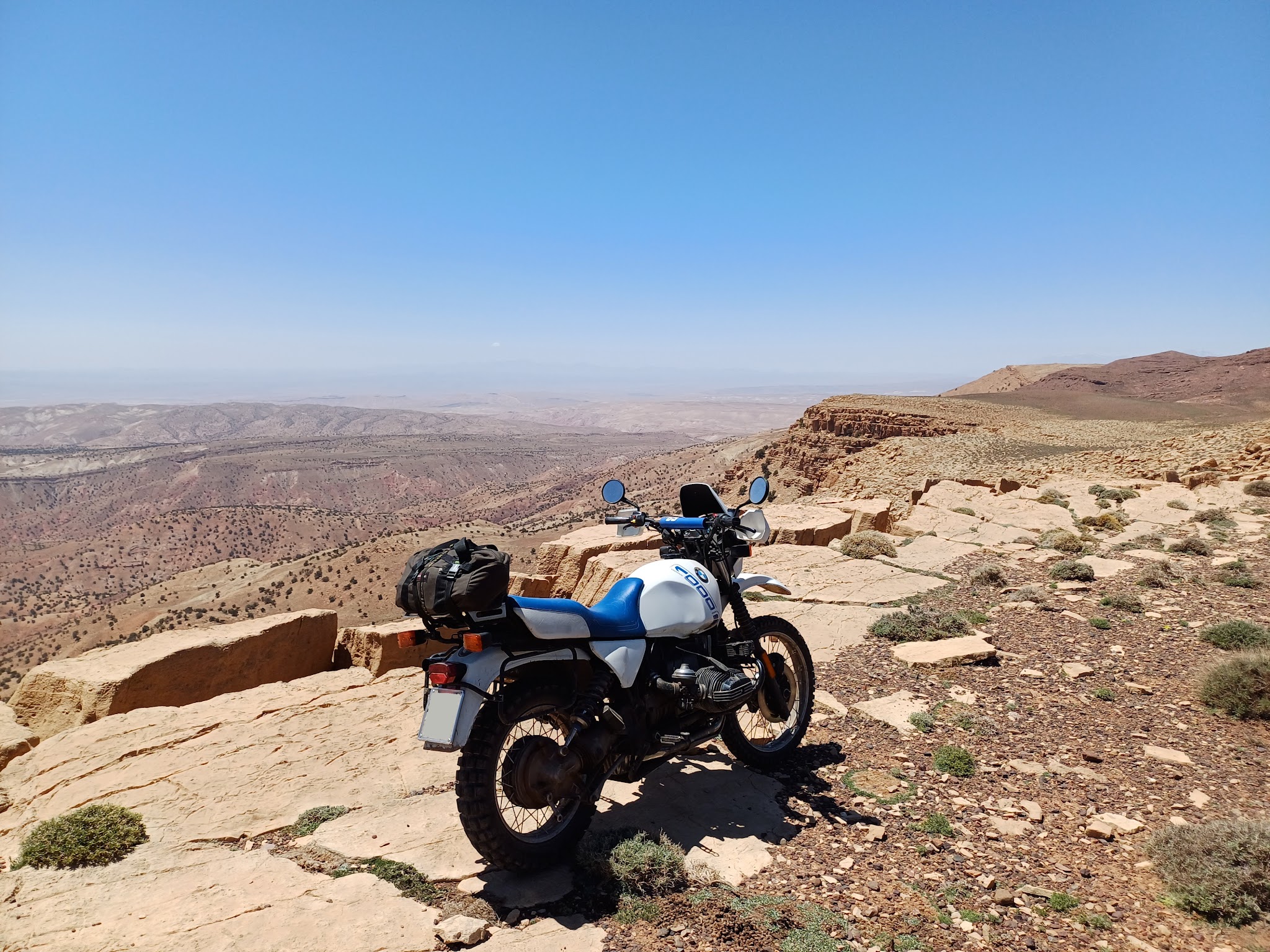
The title of this post is a reference to
this other one because even though I was accurate in what I said back then, it was incomplete simply because I had never done the type of riding I did during this multi-day offroad trip, and so I could not have known what this machine is truly capable of and how robust it is.
I was particularly worried about the gear shift selector spring breaking, so much so that I brought every tool necessary to replace it, plus gaskets and seals. It would be an extremely difficult repair to make "out in the field" but definitely possible if the alternative is to be stranded. As it turned out, I could have left almost everything at home. The only tools I needed were an 11mm spanner, a couple of CO₂ cartridges and a portable tire inflator. I'll talk about the tool kit further on.


It doesn't make sense to me given the type of tracks we rode, but I must acknowledge the fact that somehow this bike survived and actually performed far better than I could have anticipated. It felt completely unflustered and entirely unfazed no matter what I was asking of it, immediately returning to an idle state (in every sense of the word) as though it hadn't just clambered up a long and steep rocky incline, or navigated a few miles of sandy tracks in hot conditions. Thanks in part to a new rear shock absorber, even harsh bottom-outs were controlled with far less bounce or wallow on recovery. Because of how the damping circuits are built, the unit absorbed sharp hits without transmitting too much of a shock to the frame — or to me. It just... worked.
What we did must be regarded as a fully respectable test of the machine's capabilities that leaves virtually no unanswered questions; and so, if it did well here and if nothing broke or failed, then I must conclude that it really is an extremely strong machine.
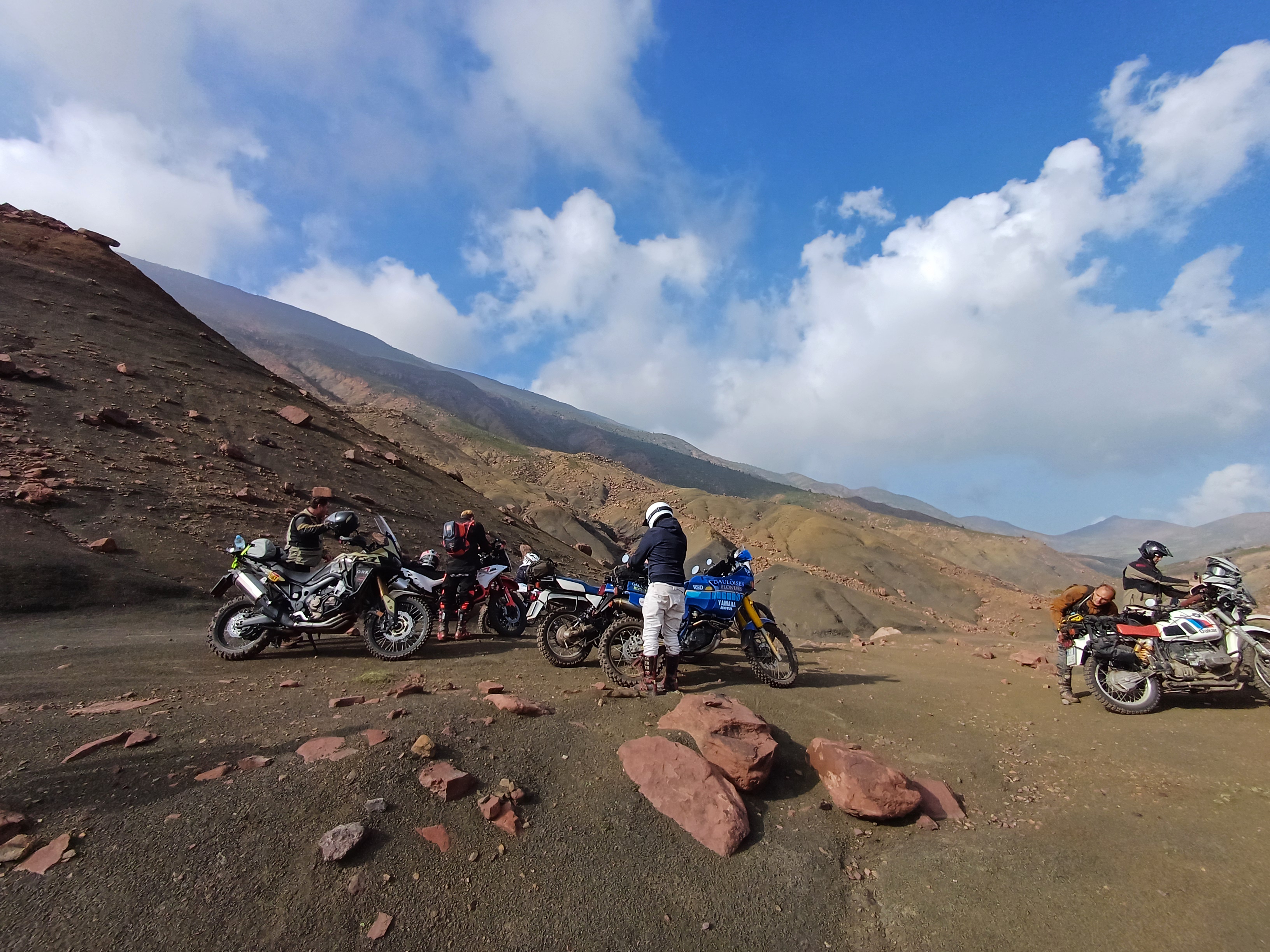
My focus here is on the motorcycle, I will not go into the trip itself right now as that was always secondary to me. Others who came along on the trip are far more involved in that aspect and will prepare a comprehensive video report, eventually.
The R100GS is in fact a very competent offroader that has surprised me in just how well it copes with pretty much anything I've thrown at it. And unfortunately sometimes I mean I literally threw the bike far too fast down a track, ended up bottoming out the suspension and bouncing over ruts or bumps in the most unsightly manner, but still the bike coped. Not only that, but it miraculously kept me out of trouble on more than one occasion: once, I came up against a deep and rather steep rut with not enough time to slow down, I had no choice but to compress front and rear suspension fully, then try to steer the bike up and over the opposing steep slope. The velocity of the whole maneuver was such that I could tell the bike had just bounced up in the air and somewhat contorted as it did so. The rear wheel was undoubtedly higher than the front, something you most definitely don't want. I thought "I'm about to be thrown off this horse for sure" but somehow we stuck the landing and continued as if nothing had happened. Another time, on a track where the sand suddenly got much deeper, the front wheel darted off to the right in search of firmer ground, to such an extreme degree that Giulio, riding behind me, says he saw the entire right-hand side of the motorcycle, only to then see the bike right itself and continue forward. Quite how I managed to stay on the bike is beyond me. There too I thought "this is a crash, for sure" but the rear wheel regained traction and we continued, again as if nothing happened.
One notable upgrade made ahead of this trip and which I hinted at earlier, was replacing the basic Hagon shock absorber that was on the bike with a much higher-spec one made by FG Gubellini: it is fully adjustable and sprung precisely for my weight and luggage, which transformed the handling overall and allowed the bike to withstand rough terrain with relative composure and precision. It was one of very few improvements I had in mind from years ago, and I'm glad to see it paid off, refining this machine into a reliable, capable tool for real on/offroad use.
Speaking of crashes, I counted five in the whole trip (that's just my personal tally): three in deep sand, very annoying but entirely harmless, two on rocky sections, which could have been more serious, though luckily nothing critical was damaged. I did bash one of the engine guards pretty hard, so that will need to be straightened or replaced, we'll see.
Another thing I noticed (and witnessed on a G/S special that was on the trip) is the actual ground clearance these bikes have. Obviously the width of the engine is always noticeable and sometimes a problem - as evidenced by the bent engine guard, though that was partly my fault. But even when climbing down a steep incline with large rocks in the way, there was never any risk of hitting the sump, which is tucked well above typical strike points. It goes without saying that the cylinders are much higher up than the sump...
Now, the undercarriage bash plates, that extend from the very front of the engine all the way back to the exhaust collector box - and thus also protect the gearbox - took quite a few hits. I often heard these loud bangs as rocks were disturbed by the passage of the front wheel and were being thrown at the underside of the bike, but inspection of the bash plates revealed no dings, scratches or gouges. They are thick enough to merit being called armor plating.
I did notice some scratch marks to the outermost side of the plate, and to the torque reaction arm at the Paralever. The latter has me wondering whether this may be a weak point since it is fairly exposed and a potential contact point under heavy compression, and whether it may be prudent to carry a spare (which I have in the garage). This isn’t just cosmetic: the torque arm is a critical component in the rear suspension's geometry that controls the suspension articulation, so any damage here could throw off handling or compromise safety.


The other thing that must be said is that this really isn't a motorcycle: it's two motorcycles wrapped in one: for once you're done fooling around offroad, you can return to the civility of paved roads and instantly access fast touring with decent handling. Some of this merit inevitably goes to Continental and their TKC80 tires, which have handled every possible scenario including water and small streams fords with total confidence. Despite their apparently aggressive tread, they maintain admirable composure on asphalt (yes, they can sometimes feel a bit vague and somewhat noisy but that's probably due to low tire pressure necessitated by the offroad sections). Once on rocks, finer gravel, packed dirt or even sand, they allow the GS to plow through pretty much anything and get the job done.
Now, suppose you're riding fast along a pristine mountain road with perfect tarmac and big sweeping corners when you spot a little fire road off in the distance, leading up to the top of a hill or something; you wanna go there and check it out? You can do that, instantly:
You get off the tarmac and onto the gravel, dirt or pretty much any other surface, get up on the footpegs and off you go: what was a competent road tourer up until a second ago is now an actual offroader, and you can have total confidence that you can make it up there and back down with no problem. And on top of that, with a luxurious feel to the whole thing that is unmatched among its peers. You don't even have to faff around with electronic settings, there aren't any! The bike is just always ready for anything.
How could I not mention the surging, turbine-smooth acceleration with the engine sound that goes "ooooo!" as it climbs up the rev range, the superlight clutch and quick gear shifts that are possible when the engine is used like that. Couple all of it with steady and extremely sensitive handling, definitely decent if you consider that you're really riding a big enduro bike on the road, where it has no business being as good as it is. Once again I have to wonder "how is this possible?" how can this bike work the way it does no matter what you do with it? It's not like you're relying on fancy electronics to switch modes and alter the behavior of the vehicle: the bike is how it is, always. And it works really well, always. What I find even harder to comprehend is that the engineers used a frame and an engine that BMW already had and had been using on their road bikes for decades, certainly long before the notion of a modern adventure bike had crossed anyone's mind. Yes, the Paralever, the Marzocchi forks and the 21/17 aluminum rims play a massive role in making the GS work, but frame and engine are also crucial... yet come from the road. So, the potential was always there, they tried it and it worked. I wonder if during the pre-production testing they were as surprised as I am.
In its historical context, the R100GS defies convention: it is many different things all at once, and they are all slightly odd versions of what you might compare it to. Is it a dirt bike? Well, kind of but not really. Is it a road tourer? Well, definitely but not like a Gold Wing. Is it a delicate and complicated machine with complex engineering and high maintenance requirements? Absolutely, but it can also take a beating. I can't make sense of it!
I have to admit, this bike is one tough unit.
Another thing I noticed and that surprised me is how forgiving the engine is of extremely low speeds without stalling. At one point on a particularly challenging combination of uphill hairpin turn, uphill gradient and what felt like loose, deep, smooth pebbles I slowed down in first gear to the point where I thought "well you've done it now you idiot, now the bike's gonna die, you're gonna loose traction and you'll have to hold the whole weight of it on one leg". But to my surprise the engine was still turning smoothly, with no sign of stutter or knock, and responded to the throttle by digging the rear wheel in until the TKC80 found traction and I was able to power out of the spot and continue up the slope. Wow...
Let me not forget about the tool kit, for which I reached several times during the trip... mostly to assist others. The full size quality tools are the original ones selected by BMW, they impress again and again, and the storage compartment is so generously sized as to accommodate additional items such as the oil cooler bypass hose, a spare rear brake lever, three small containers with various bits and ends, a spare headlight bulb and two CO₂ canisters. Oh, and a Leatherman. I will make some very minor adjustments to the kit but I won't pare it down. I'd like to be realistic and reasonable about this: prepared for most things without going overboard and carrying too much stuff (which I probably did this time).
Then there is something which is really very clever: the top spine tube of the BMW's frame is a hollow, oval section tube. It is long enough that it can accommodate a nifty stash tube that can be used to carry additional small tools (like sockets, extension bars, a metal file) or additional CO₂ cartridges, something I will always carry on all trips from now on, regardless of what bike I'll be riding and with which tire type. You can see it in the photo below, laying across the frame:
So, to answer the all-important question that prompted the Morocco trip in the first place, "do I like this bike?", I can only say yes, I do like this bike. Very much so, in fact...
The thing about the R100GS is this: it only really makes sense owning one if you're going to use it on and off the road. Treating it like a road tourer, no matter the distances and luggage involved is wasted potential (and there are plenty of specialized road tourers that can be far better at that one specific task than a GS). Much in the same way as the Sportster 1200S only makes sense if you unleash all it can give you, the R100GS will only show its true self if you allow it to blend tarmac, gravel, rocks, earth tracks and even sand for you; I must concede that it was obviously engineered this way, with versatility and this duality to every single aspect of the final product. Give it a chance and room to show you what it can do: it will surprise you.